
Since Claude arrived, my friends have been getting the short end of the stick. I see openings everywhere to build, explore or reorganise something with AI. Meanwhile my company is growing fast, my daughters want my attention, and I would love to see my friends more often too. The time I think I’m saving with AI, I pour with suspicious ease into yet another idea with AI.
The same thing happens inside a company. AI makes it easier to float a trial balloon. When a test succeeds, that is when the work starts for everyone else: someone has to learn the new way of working, handle the exceptions and make sure the process survives a busy Monday. An experiment can be finished for the person who dreamed it up while the change for the team is only just beginning.
And “I saved time, so I’ll take on more” turns out to be no personal quirk. Researchers spent eight months inside a tech company and watched a feedback loop take hold: AI speeds up a task, expectations climb to match, so everyone leans harder on AI and the work grows instead of shrinking - with fatigue and burnout as the price (Axios on the UC Berkeley study). The time saved evaporates into higher demands. Exactly what I catch myself doing at night.
Floating trial balloons is part of the job
In uncertain times you still want to find out for yourself where AI adds value. In a field experiment with 758 consultants, AI sharply improved performance on many tasks, while those same consultants more often got it wrong on one task that sat beyond the model’s reach (Dell’Acqua et al., Organization Science). For me that is no reason to bail out, but a reason to test small and concrete. Can AI help flag anomalies in purchase orders, say? How long does it take to check the suggestions? Which anomalies does the system miss? Those answers tell you whether the test deserves a sequel.
The organisational scholar James March described the underlying tension back in 1991. He called it exploration, the search for new possibilities, and exploitation, making better use of what you already have (March, Organization Science). Both draw on the same scarce time and attention, and their payoffs arrive at different moments. How much change you ask for at once is therefore a decision about your company’s capacity, just like how much work you take on. Ask for too much at once and change fatigue sets in: research ties that fatigue directly to exhaustion among employees (Bernerth et al., Work & Stress). The bow cannot stay drawn forever.
We just keep working through the renovation
For many businesses this strikes me as a workable rhythm. Float trial balloons on purpose. Then bundle the changes that belong together into one planned leap. Give the team time to get the new way of working under their belt, and see what it delivers in practice. Meanwhile customers still need helping and invoices still need sending. So reserve capacity for that work too when you plan the leap.
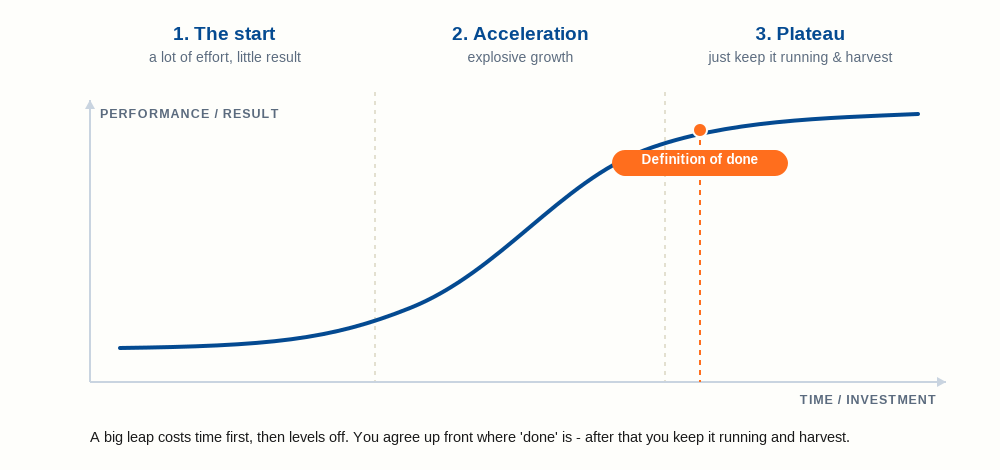
An S-curve shows how performance develops during such a leap. At first the switch mostly costs time, then the result improves quickly, and in the end the growth levels off. In that last phase you see what the gain in daily work really is, including the time that oversight and maintenance take.
How we agree up front when it is done
On a large implementation we work in phases with acceptance criteria agreed in advance. Before we start, we pin down what has to work, who takes it over, and how we will see that the team can carry on without us. That is our definition of done for the whole change. We adjust along the way based on what we learn, but a new idea only earns a place in the delivery when it is needed to hit the agreed result. That keeps the leap a leap, not an endless string of small course corrections.
Sometimes the leap is allowed to grow instead. Say a client rolls out a new ERP and, while they are at it, redesigns the entire purchasing process and its data. Then we test right away whether AI helps spot deviating orders sooner. The same change also builds the client’s own ability to work with AI: buyers learn to judge the signals, someone at the client maintains the tool, and the team tests the next idea itself with real orders. That is what I mean by teaching the client to fish.
After that comes a stretch of just running the shop. Are buyers now working with the system on their own? Do they catch deviations earlier? How much extra checking does that cost? Only once the daily work answers those questions do we know what the leap was worth.
I can use that same agreement on myself. If Claude sparks yet another good idea tonight, I’ll write it down and look at it tomorrow. Tonight I could also just call a friend.
Curious how we lock down a big step in advance, so your team doesn’t drown in it? See our TARGET approach or book a no-obligation call.
Read more: The hidden price of bad software · Turn your ERP implementation into an AI project